A Practical Guide to Reducing Taxable Business Income and Avoiding Missed Deductions
Running a small business in Canada involves more than managing customers, sales, and daily operations. Business owners must also track expenses, maintain financial records, and understand which costs can be deducted when preparing their tax returns.
One common mistake is overlooking legitimate business expenses. Whether you operate as a sole proprietor, freelancer, consultant, contractor, or incorporated business owner, knowing which deductions may apply can help you manage your tax obligations more effectively.
The Canada Revenue Agency (CRA) generally allows businesses to deduct reasonable expenses incurred to earn business income, subject to specific restrictions.
But not every expense qualifies, and some costs must be claimed over several years rather than deducted immediately.
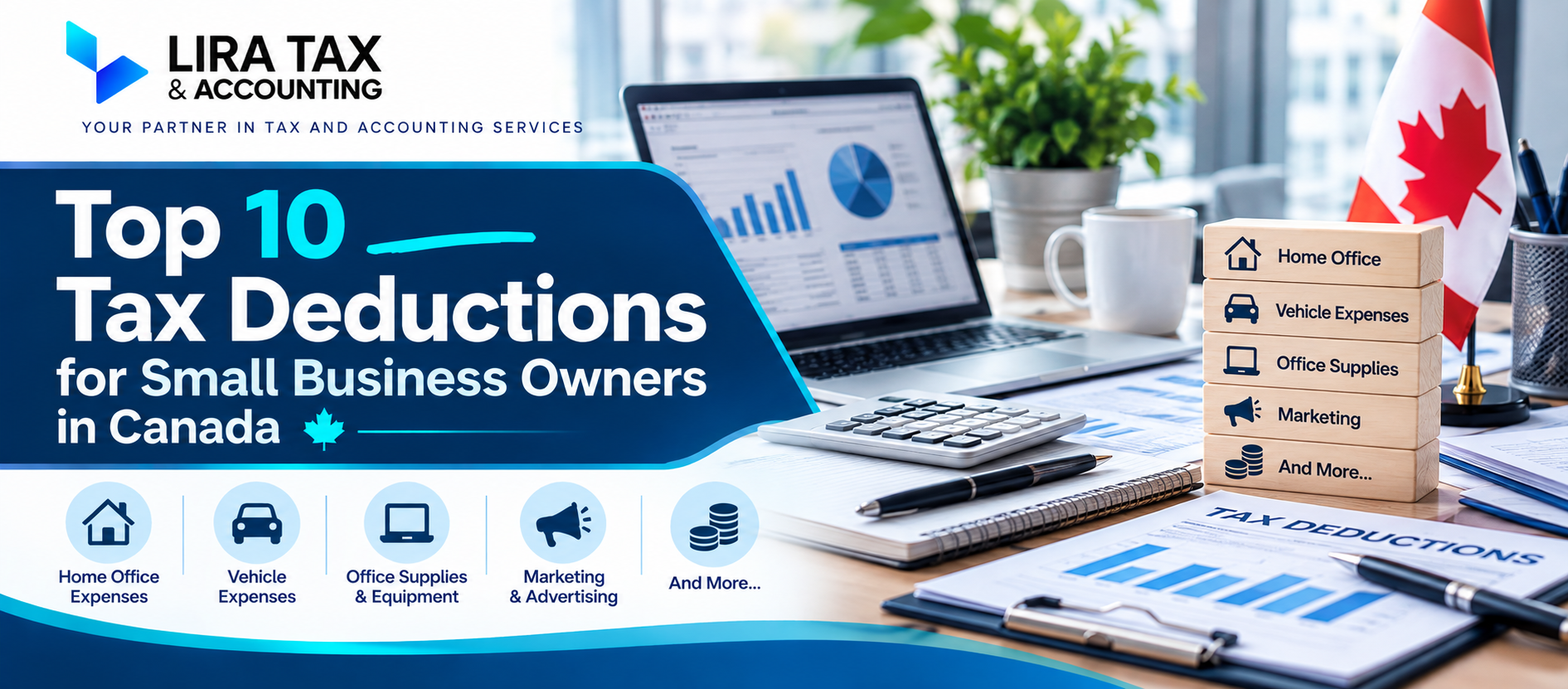
In this guide, Lira Tax & Accounting explains ten common tax deductions for Canadian small business owners, provides practical examples, and discusses what to do if you have missed deductions or have unfiled business tax returns.
What Are Small Business Tax Deductions in Canada?
A business tax deduction is an eligible expense that reduces the income on which your business pays tax.
For example, suppose your business earned $100,000 in revenue and incurred $35,000 in eligible deductible expenses.
- Description
- Amount
- Business revenue
$100,000
Eligible deductible expenses
$35,000
Net business income
$65,000
In this simplified example, your net business income is $65,000 before any other applicable tax adjustments.
This does not mean you receive $35,000 back from the CRA. Instead, eligible expenses reduce the income used to calculate your tax.
The amount of tax saved depends on your business structure, applicable tax rates, and individual circumstances.
Important: Business deductions must be supported by proper records, and personal expenses generally cannot be claimed as business expenses.
1. Home Office Expenses
Many Canadian entrepreneurs operate their businesses from home.
If you use part of your home for business purposes, you may be eligible to deduct a portion of certain household expenses.
Common eligible expenses may include:
- Rent
- Electricity and heating
- Home insurance
- Maintenance and minor repairs
Certain mortgage interest and property taxes, where permitted
Example: Home Office Deduction
Suppose your home is 1,500 square feet, and you use a dedicated 150-square-foot office exclusively for your business.
Your office represents 10% of your home's total area.
If your eligible annual household expenses total $18,000, your preliminary business-use allocation could be:
$18,000 × 10% = $1,800
However, the actual deduction depends on the type of expenses, business use, workspace arrangements, and applicable CRA rules.
If the space is also used personally, you may need to adjust the calculation for the time it is used for business.
For sole proprietors, business-use-of-home expenses generally cannot create or increase a business loss, although unused eligible amounts may be carried forward under applicable rules.
Tax Tip: Keep records of your workspace measurements and household expenses to support your calculation.
2. Motor Vehicle Expenses
If you use a vehicle to operate your business, visit clients, deliver products, or travel between business locations, you may be able to deduct the business portion of eligible vehicle expenses.
Common expenses include:
- Fuel
- Insurance
- Vehicle maintenance and repairs
- Licence and registration fees
- Eligible vehicle loan interest
- Leasing costs
Capital cost allowance (CCA), where applicable
Example: Business Vehicle Deduction
Suppose you drove 20,000 kilometres during the year, including 8,000 kilometres for business.
Your business-use percentage would be:
8,000 ÷ 20,000 × 100 = 40%
If your eligible annual vehicle operating expenses total $6,000:
$6,000 × 40% = $2,400
You may be able to claim $2,400 in business-related operating expenses, assuming the costs are otherwise deductible.
Additional limits apply to certain passenger vehicles, financing costs, and leases.
Tax Tip: Maintain a mileage log showing dates, destinations, business purposes, and kilometres driven. Ordinary commuting between home and a regular workplace is generally personal travel.
3. Office Supplies and Business Equipment
Small businesses regularly purchase items needed for daily operations.
Common deductible office supplies include:
- Paper and notebooks
- Pens and stationery
- Printer ink
- Envelopes and postage
- Other consumable office supplies
However, expensive equipment and long-lasting assets may need different tax treatment.
For example, a computer, office desk, or filing cabinet may qualify as a capital asset rather than an ordinary office expense.
Understanding Capital Cost Allowance
The CRA generally requires businesses to deduct the cost of depreciable capital property through the capital cost allowance system, subject to applicable immediate-expensing and other special rules.
This means the entire purchase price may not be deductible as a regular operating expense in the year of purchase.
Tax Tip: Separate routine office supplies from capital purchases in your bookkeeping records.
4. Advertising and Marketing Expenses
Marketing is essential for attracting customers and growing a business.
Eligible advertising expenses may include:
- Google Ads
- Facebook and Instagram advertising
- Website advertising
- Business cards and promotional materials
- Certain sponsorship and promotional expenses
- Advertising agency fees
- Example: Digital Advertising Expenses
Suppose your business spends $300 per month on eligible online advertising.
$300 × 12 months = $3,600
If the full amount qualifies under the applicable rules, your business may deduct $3,600 in advertising expenses.
Special restrictions apply to certain advertising in newspapers, periodicals, and broadcasting, particularly when Canadian content or ownership requirements are involved.
Tax Tip: Keep advertising invoices, payment confirmations, and records identifying the business purpose of each campaign.
- Accounting, Bookkeeping, and Professional Fees
Many business owners hire accountants, bookkeepers, and other professionals to help manage financial records and meet tax filing requirements.
Eligible professional expenses may include:
- Bookkeeping services
- Business accounting fees
- Corporate tax preparation
- Business-related legal services
- Professional consulting fees
- GST/HST return preparation
- Example: Accounting and Bookkeeping Expenses
Suppose your business pays:
Bookkeeping services: $1,800
Corporate tax preparation: $1,200
Business consulting: $500
Total eligible professional expenses: $3,500
Assuming all amounts qualify as current business expenses, they may generally be deducted when calculating business income.
Some professional fees connected with acquiring capital property or establishing a capital structure may require different treatment.
Tax Tip: Professional accounting services can help identify missed expenses, maintain accurate records, and reduce filing errors.
6. Business Rent and Utilities
If you rent commercial space for your business, eligible rent and operating expenses may generally be deductible.
Examples include:
- Office rent
- Retail store rent
- Warehouse rent
- Electricity
- Heating
- Water
- Business telephone and internet services
- Example: Commercial Office Rent
Suppose your business pays $1,500 per month for office rent.
$1,500 × 12 months = $18,000
If the premises are used entirely for business and the rent is otherwise eligible, the business may generally deduct $18,000 in annual rent expenses.
If a telephone or internet service is used for both business and personal purposes, only the eligible business portion should be claimed.
Tax Tip: Keep lease agreements, utility bills, and payment records.
- Employee Salaries, Wages, and Benefits
Businesses that employ staff may generally deduct reasonable compensation paid for work performed in the business.
Eligible expenses may include:
- Employee salaries
- Hourly wages
- Bonuses
- Employer CPP contributions
- Employer EI premiums
- Eligible employee benefits
- Example: Payroll Expenses
Suppose a small business pays employees $75,000 in annual wages and incurs $7,500 in eligible employer payroll contributions.
Total potential payroll deduction:
$75,000 + $7,500 = $82,500
This example assumes the expenses are reasonable, properly recorded, and deductible.
Business owners should distinguish employee compensation from personal withdrawals.
For example, a sole proprietor cannot deduct their own drawings as wages. In an incorporated business, salary paid to a shareholder-employee may be deductible when the applicable requirements are met, but dividends are not deductible corporate expenses.
Tax Tip: Maintain accurate payroll records and ensure that source deductions, T4 slips, and CRA remittances are completed correctly.
8. Business Insurance Premiums
Insurance helps protect businesses from financial risks.
Certain premiums may qualify as deductible business expenses.
Examples include:
- Commercial general liability insurance
- Professional liability insurance
- Commercial property insurance
- Business interruption insurance
- Other eligible business-related insurance
- Example: Business Insurance
Suppose your business pays $150 per month for an eligible commercial liability insurance policy.
$150 × 12 months = $1,800
The business may generally deduct the eligible premium expense.
However, life insurance and certain other insurance arrangements are subject to different rules and are not automatically deductible.
Tax Tip: Keep copies of insurance policies, invoices, and payment records.
- Business Travel, Meals, and Entertainment
Business owners sometimes travel to meet clients, attend conferences, or conduct other business activities.
Eligible travel expenses may include:
- Airfare
- Hotel accommodations
- Business-related transportation
- Taxi and rideshare fares
- Certain conference-related expenses
Meals and entertainment are treated differently.
In most cases, the CRA limits the deduction for eligible meals and entertainment to 50% of the reasonable expense, although exceptions apply.
Example: Client Business Lunch
Suppose you spend $200 on an eligible business meal with a client.
$200 × 50% = $100
The deductible portion would generally be $100.
This assumes the expense meets CRA requirements and is not subject to a special exception.
Tax Tip: Keep receipts and record who attended, the business purpose, and the date of the meeting.
Personal vacations and ordinary personal meals are not deductible merely because you own a business.
- Bank Charges, Business Loan Interest, and Financing Expenses
Small businesses often incur costs when managing business bank accounts or financing their operations.
Potentially deductible expenses include:
- Business bank account fees
- Credit card processing fees
- Merchant service charges
- Eligible interest on business loans
- Certain financing expenses
- Example: Business Banking Expenses
Suppose your business incurs:
Monthly bank fees: $300 annually
Payment processing fees: $1,200 annually
Eligible business loan interest: $1,500 annually
Total potential deduction: $3,000
The interest must generally relate to borrowed money used for an eligible income-earning purpose, and other conditions or limitations may apply.
Tax Tip: Keep business and personal banking transactions separate whenever possible.
Bonus: Inventory and Cost of Goods Sold
For retail businesses, restaurants, wholesalers, and other businesses selling products, inventory is a major consideration.
Inventory purchases are not necessarily deductible in full when purchased.
Instead, the cost of goods sold is generally determined by considering opening inventory, purchases, and closing inventory.
- Example
- Description
- Amount
- Opening inventory
$10,000
Inventory purchases
$40,000
Closing inventory
$8,000
Cost of goods sold
$42,000
This simplified calculation shows how inventory affects business income.
Maintaining accurate inventory records is important for preparing financial statements and tax returns.
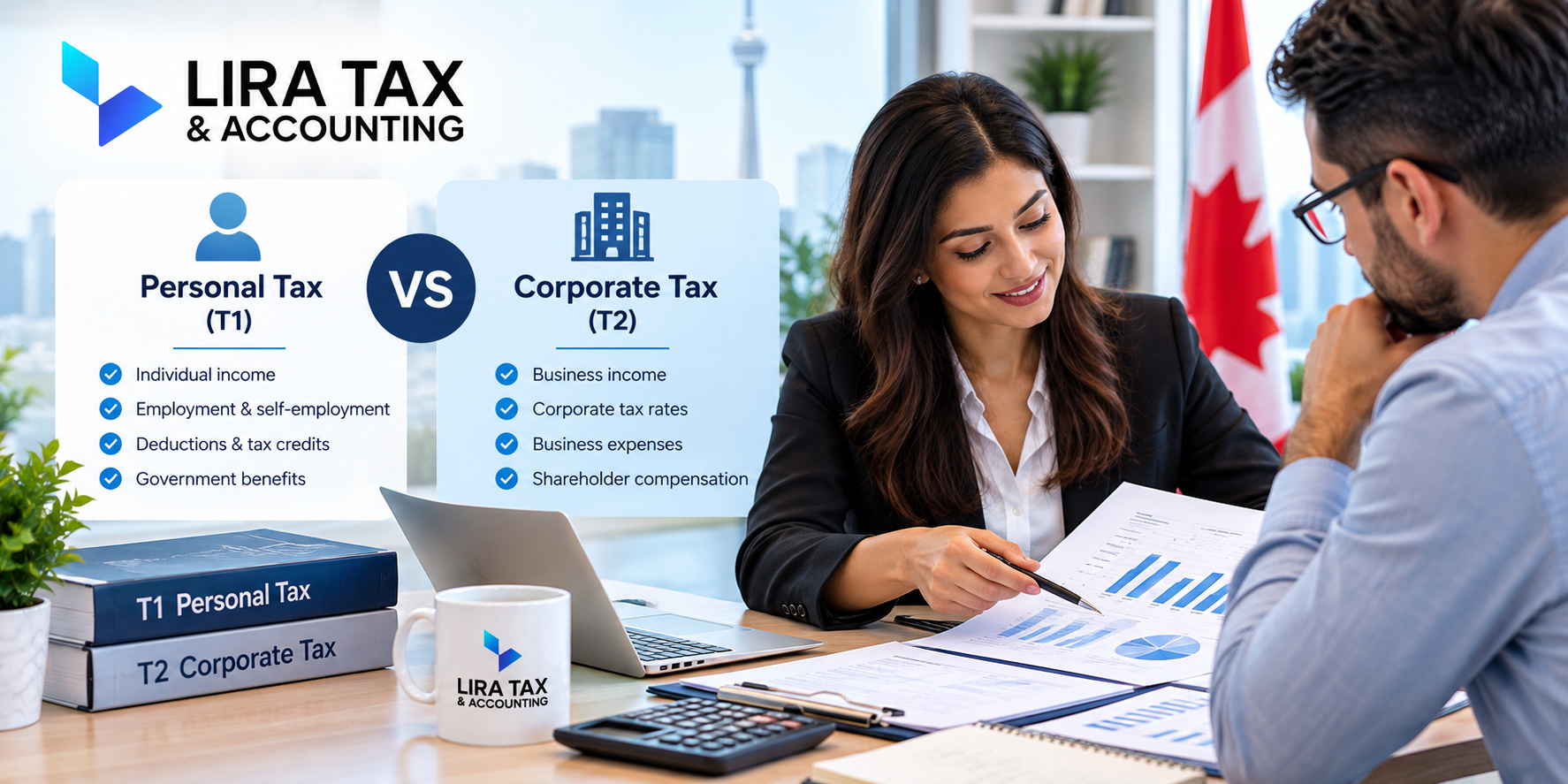
Personal Tax vs. Corporate Tax: How Do You Claim Business Deductions?
The way business deductions are reported depends on how your business is structured.
Sole Proprietors and Self-Employed Individuals
Sole proprietors generally report business income and expenses on Form T2125, Statement of Business or Professional Activities, as part of their personal T1 income tax return.
Eligible business expenses reduce net business income, which is included in the owner's personal tax calculation.
Incorporated Businesses
An incorporated business generally files a separate T2 Corporation Income Tax Return.
Eligible corporate expenses are included in the calculation of corporate income for tax purposes.
A corporation and its owner are separate taxpayers. Personal expenses should not be treated as corporate expenses simply because the business pays for them.
Proper accounting is essential for tracking shareholder transactions, payroll, dividends, and business deductions.
What If You Forgot to Claim Business Expenses on a Previous Tax Return?
This is a common concern for Canadian business owners.
You may discover that you forgot to include:
- Business mileage
- Home office expenses
- Accounting fees
- Advertising costs
- Insurance premiums
- Bank charges
- Other eligible business expenses
If you have already filed your return, you may be able to request an adjustment to correct eligible expenses.
For personal tax returns, the CRA provides methods for requesting changes to previously filed returns, including Change My Return and Form T1-ADJ.
For corporate returns, an amended T2 return may be appropriate, depending on the circumstances.
The applicable tax year, reassessment period, supporting documentation, and type of correction must be considered.
Important: You should not claim the same expense twice or move an expense into a different tax year simply because you missed it originally.
Have Unfiled Business Tax Returns in Canada?
If you have one or several years of outstanding business tax returns, you are not alone.
Some business owners fall behind because of incomplete bookkeeping, missing receipts, financial difficulties, or uncertainty about their filing obligations.
However, delaying tax filing can lead to additional complications.
Depending on your circumstances, consequences may include:
- Late-filing penalties where applicable
- Interest on unpaid taxes
- CRA requests for outstanding returns
- Estimated assessments
- Difficulty obtaining accurate financial statements
- Additional bookkeeping and compliance problems
- How to Catch Up on Previous Years' Business Taxes
- Step 1: Identify Outstanding Returns
Determine whether you need to file personal T1 returns, corporate T2 returns, GST/HST returns, payroll filings, or a combination of these.
Step 2: Gather Financial Records
Collect bank statements, invoices, receipts, payroll reports, and previous tax documents.
Step 3: Reconstruct Missing Bookkeeping
Organize income and expenses for each outstanding tax year.
Step 4: Review Eligible Deductions
Identify legitimate business expenses and ensure that they are claimed in the correct periods.
Step 5: Prepare and File Outstanding Returns
Complete the required filings using the applicable tax rules for each year.
Step 6: Address CRA Balances and Correspondence
Review any outstanding tax balances, interest, penalties, or CRA requests.
If appropriate, explore available CRA payment arrangements or relief programs.
At Lira Tax & Accounting, we assist individuals and incorporated businesses with previous years' tax preparation, bookkeeping, and CRA correspondence.
Common Tax Deduction Mistakes Small Business Owners Should Avoid
Even legitimate business expenses can cause problems when they are recorded incorrectly.
Common mistakes include:
Claiming Personal Expenses as Business Expenses
Personal groceries, family vacations, and other private expenses generally cannot be deducted as business expenses.
Failing to Keep Receipts
Bank statements alone may not establish all the details needed to support a deduction.
Claiming 100% of Mixed-Use Expenses
Vehicles, internet services, and home offices used partly for personal purposes generally require reasonable allocations.
Deducting Capital Assets Incorrectly
Equipment and other capital purchases may be subject to CCA or special immediate-expensing rules.
Double-Claiming GST/HST
If a business claims an input tax credit for eligible GST/HST paid on an expense, the corresponding business expense generally must be reduced by that recovered amount.
Missing Previous Years' Expenses
Poor bookkeeping can result in overlooked deductions and inaccurate tax returns.
How Long Should Small Businesses Keep Tax Records?
The CRA generally requires businesses to keep supporting tax records for at least six years from the end of the last tax year to which they relate.
Certain records must be kept longer, and special rules apply in some circumstances.
Examples of important records include:
- Sales invoices
- Purchase receipts
- Bank statements
- Payroll reports
- GST/HST records
- Mileage logs
- Financial statements
- Tax returns and notices of assessment
Maintaining organized records throughout the year makes tax preparation easier and helps support deductions if the CRA reviews or audits your return.
Frequently Asked Questions About Small Business Tax Deductions in Canada
1. Can I deduct all my business expenses in Canada?
No. Expenses must meet CRA requirements. Some are partially deductible, while capital expenditures and personal expenses are treated differently.
2. Can I claim home office expenses if I am self-employed?
Yes, if you meet the applicable CRA conditions. The deduction generally depends on the business use of your home and the eligible expenses incurred.
3. Can I deduct my car payment as a business expense?
Not automatically. Eligible vehicle operating expenses, financing interest, leasing costs, and capital cost allowance are subject to different rules and limitations. Personal use must be excluded.
4. Are accounting fees tax deductible for a small business?
Business-related accounting, bookkeeping, and tax preparation fees are generally deductible, subject to the applicable rules.
5. Can I deduct Google Ads and Facebook advertising expenses?
Generally, eligible digital advertising expenses incurred to promote your business may be deductible, subject to CRA rules.
6. Can I claim business expenses if I have no profit?
You may be able to claim eligible expenses even if your business reports a loss. However, special restrictions apply to certain expenses, including business-use-of-home expenses, and the activity must qualify as a business for tax purposes.
7. Can I claim expenses from previous years?
You may be able to request an adjustment to a previously filed return, depending on the year, available documentation, and applicable reassessment rules.
8. Can I claim deductions if I have not filed my business taxes for several years?
Yes, eligible expenses may be claimed when preparing outstanding returns for the correct tax years, provided the expenses meet the applicable rules and can be supported.
9. Does a corporation claim the same expenses as a sole proprietor?
Many expense categories are similar, but the tax treatment can differ because a corporation is a separate legal taxpayer. Shareholder compensation and personal expenses require particular attention.
10. Can an accountant help identify missed tax deductions?
Yes. An accountant can review financial records, identify potentially deductible expenses, and help prepare accurate tax returns.
How Lira Tax & Accounting Can Help Your Small Business
Managing business expenses, bookkeeping, and tax filings can become complicated, especially when you operate a growing business or have outstanding returns from previous years.
Lira Tax & Accounting provides tax preparation and accounting services for individuals, self-employed professionals, and incorporated businesses.
Our services include:
Personal Tax Preparation (T1): Tax filing for individuals and self-employed business owners.
Corporate Tax Preparation (T2): Corporate income tax preparation and related accounting support.
Previous Years' Tax Returns: Assistance with outstanding personal and corporate tax filings.
Bookkeeping and Bank Reconciliation: Organizing business income, expenses, and financial records.
GST/HST Filing: Assistance with sales tax reporting and compliance.
Payroll Services: Payroll processing, source deduction records, and reporting.
CRA Correspondence Assistance: Helping clients understand CRA requests and prepare supporting documentation.
Whether you are preparing your current tax return, reviewing missed deductions, or catching up on several years of unfiled taxes, our team can help you organize your financial information and understand your filing obligations.
Final Thoughts: Don't Overlook Eligible Business Tax Deductions
Understanding small business tax deductions in Canada can help you report income accurately and avoid paying more tax than required.
From home office expenses and vehicle costs to advertising, payroll, insurance, and professional fees, eligible deductions can make a meaningful difference to your business's taxable income.
The key is to maintain accurate records, separate personal and business expenses, and apply CRA rules correctly.
If you have missed deductions or have unfiled business tax returns, addressing them promptly can help reduce future complications.
Need Help With Small Business Taxes or Previous Years' Tax Returns?
Contact Lira Tax & Accounting for professional assistance with personal and corporate tax preparation, bookkeeping, GST/HST, payroll, and outstanding tax returns.
We proudly serve small business owners and individuals in Toronto, East York, Scarborough, and across Canada.
Lira Tax & Accounting | Your Partner in Tax and Accounting Services
Disclaimer: This article provides general information about Canadian small business taxation. Eligibility for deductions depends on the business structure, tax year, supporting documentation, and applicable CRA rules. Consult a qualified tax professional about your specific circumstances.