How to File Unfiled Tax Returns in Canada: A Complete Guide to Back Tax Filing
Have you missed filing your income tax returns for one year, three years, or even five years? If so, you may be wondering how to catch up, whether the Canada Revenue Agency (CRA) will charge penalties, and what happens if you owe taxes.
The good news is that you can still file previous years' tax returns in Canada, even if several years have passed.
Many Canadians fall behind on their taxes because of financial difficulties, missing documents, changes in employment, business responsibilities, or simply not knowing where to begin.
Regardless of the reason, leaving tax returns unfiled can create additional financial problems. Taking action can help you understand your tax obligations, address outstanding balances, and potentially recover refunds or government benefits.
At Lira Tax & Accounting, we help individuals, self-employed professionals, and business owners organize their tax records and prepare outstanding tax returns.
In this guide, we explain how to file unfiled tax returns in Canada, what penalties may apply, and how professional tax preparation services can help you get back on track.
1. What Are Unfiled Tax Returns?
An unfiled tax return is an income tax return that has not been submitted to the CRA for a particular tax year.
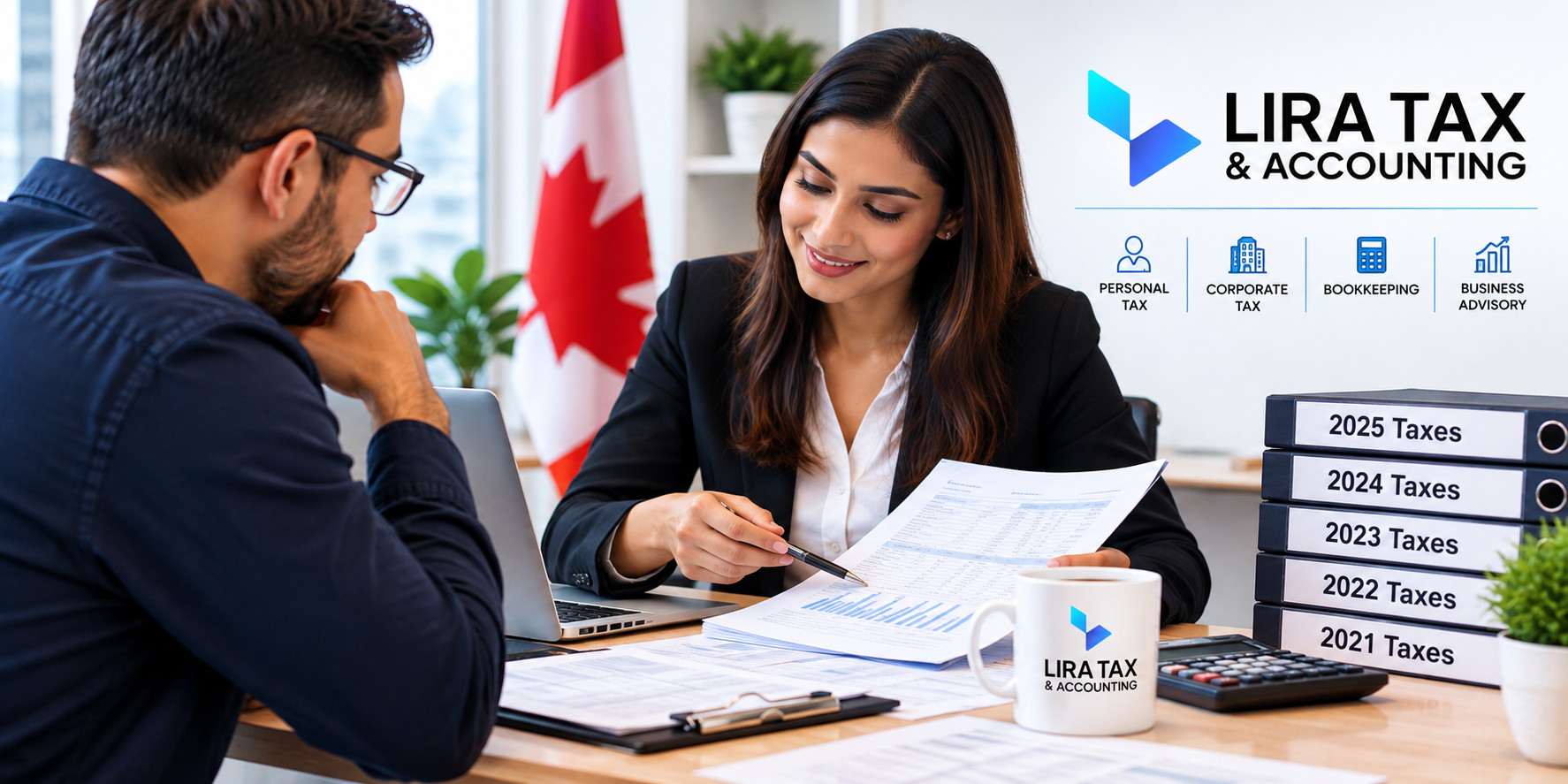
For example, suppose you were required to file income tax returns for 2021, 2022, 2023, 2024, and 2025 but did not submit any of them. You would have five years of outstanding tax returns.
This situation can affect different types of taxpayers, including:
- Employees who received T4 employment income
- Self-employed individuals and freelancers
- Small business owners
- Incorporated businesses
- Individuals earning rental or investment income
- Newcomers to Canada who need to establish their tax filing history
Not everyone is legally required to file a return every year. However, filing may still be necessary to claim refunds, receive certain benefits, or establish eligibility for income-tested government programs.
2. What Happens If You Do Not File Your Taxes in Canada?
Failing to file required tax returns can have several consequences.
CRA Late-Filing Penalties
If you owe income tax and file your return after the deadline, the CRA generally charges a late-filing penalty.
The standard penalty is:
5% of the unpaid balance, plus 1% for each full month the return is late, up to 12 months.
For example, assume you owe $5,000 in income tax and file your return six full months late.
| Description | Amount |
|---|---|
| Outstanding tax balance | $5,000 |
| Initial late-filing penalty (5%) | $250 |
| Additional penalty (1% × 6 months) | $300 |
| Total late-filing penalty | $550 |
| Tax balance plus filing penalty | $5,550 |
This example excludes interest and any other applicable penalties.
In certain repeated late-filing situations, the penalty can increase to 10% of the balance owing, plus 2% for each full month late, up to 20 months.
Interest on Outstanding Taxes
The CRA also charges compound daily interest on unpaid income taxes, starting from the applicable payment deadline.
Interest rates may change quarterly. Consequently, an outstanding tax balance can continue increasing until it is paid.
Delayed Government Benefits and Tax Credits
Unfiled tax returns can delay or interrupt certain benefits and credits, including:
- GST/HST credit
- Canada Child Benefit (CCB)
- Canada Workers Benefit (CWB)
- Certain provincial and territorial benefits
The CRA uses information from income tax returns to determine eligibility for many income-tested benefits.
CRA Notices and Collection Actions
If you are required to file and fail to do so, the CRA may issue a request or formal demand to file.
Depending on the circumstances, continued non-compliance can result in assessments, enforcement measures, and collection action.
Addressing outstanding returns promptly can help clarify your actual tax position and reduce the risk of further complications.
3. Can You File Taxes for Previous Years in Canada?
Yes. You can file tax returns for previous years, including multiple outstanding years.
For example, if you have not filed your personal taxes for the past five years, you can prepare and submit the outstanding returns for each applicable tax year.
In 2026, the CRA's NETFILE service supports eligible original personal income tax returns for the 2018 through 2025 tax years.
Returns for older years, or returns that do not qualify for electronic filing, may need to be submitted using another accepted filing method.
It is important to prepare each return using the tax rules, forms, income information, and applicable credits for that particular year.
A qualified tax preparer can help determine which years require filing and the appropriate submission method.
4. How to File Unfiled Tax Returns in Canada: Step-by-Step
Step 1: Identify Your Missing Tax Years
Start by determining which tax years have not been filed.
You can review your CRA My Account, previous Notices of Assessment, and personal records.
If you are unsure about your filing history, an authorized tax representative may help you review the available CRA information.
For example, you may discover that your 2021 and 2022 returns were filed, but your 2023, 2024, and 2025 returns are outstanding.
Knowing exactly which returns are missing helps avoid unnecessary work and duplicate submissions.
Step 2: Gather Your Tax Documents
Collect the financial documents for each outstanding tax year.
Common documents include:
For employees:
- T4 employment income slips
- T4A slips
- T5 investment income slips
- T3 trust income slips
- RRSP contribution receipts
- Tuition tax slips
- Eligible donation receipts
- Medical expense records
For self-employed individuals:
- Business income records
- Sales invoices
- Business expense receipts
- Bank statements
- Vehicle expense records
- Home office expense information
- GST/HST records, where applicable
For incorporated businesses:
- Financial statements
- General ledger
- Bank reconciliations
- Payroll records
- Corporate tax information
- GST/HST filing records
- Prior corporate tax returns and Notices of Assessment
If some documents are missing, do not assume that filing is impossible.
Certain tax slips may be available through CRA online services. Other records may need to be requested from employers, financial institutions, clients, or previous accountants.
Step 3: Prepare Each Outstanding Tax Return
Once your documents are organized, prepare the return for each missing year.
Each return should reflect the income, deductions, credits, and relevant tax legislation applicable to that year.
For example, someone who worked as an employee in 2021 but became self-employed in 2023 may have different reporting requirements for those years.
Carefully reviewing changes in employment, business activities, residency, and family circumstances helps ensure the returns are accurate.
Step 4: Submit Your Back Tax Returns to the CRA
After preparation, submit the outstanding returns using an accepted CRA filing method.
Depending on the tax year and your circumstances, you may be able to file electronically through certified software or an authorized tax preparer.
Some older or restricted returns may require paper filing.
Keep copies of the submitted returns and filing confirmations for your records.
Step 5: Review Your CRA Notices of Assessment
After processing your returns, the CRA will issue Notices of Assessment.
These documents generally show:
- Reported and assessed income
- Tax credits and deductions
- Refunds or balances owing
- Assessed penalties and interest
- Changes made by the CRA
Review each assessment carefully and compare it with the submitted return.
If the CRA requests additional documentation, respond within the specified timeframe.
Step 6: Address Any Outstanding Tax Balance
If you owe taxes, determine how much is payable, including applicable interest and penalties.
If you cannot pay the entire balance immediately, contact the CRA to discuss available payment arrangements.
Filing outstanding returns is still an important step even when you cannot pay the full amount at once.
5. What If You Have Not Filed Taxes for Five or More Years?
Having five or more years of unfiled returns may seem overwhelming, but the process can be managed systematically.
Consider the following example.
Example: Five Years of Unfiled Personal Tax Returns
A taxpayer in Toronto has not filed income tax returns from 2021 through 2025.
During this period, the taxpayer:
- Worked for two employers
- Received employment income
- Earned some self-employment income
- Made RRSP contributions
- Had eligible medical expenses
- Changed residential addresses
Instead of estimating income or submitting incomplete returns, the taxpayer should first reconstruct the financial information for each year.
The next step is to prepare all five returns accurately, determine any refunds or balances owing, and submit them to the CRA.
Where appropriate, professional assistance can make the process easier, particularly when employment and business income are involved.
Important: Filing several years together does not automatically eliminate penalties or guarantee refunds. Each return is assessed according to the applicable tax rules.
6. Can You Get a Tax Refund for Previous Years?
Yes. You may qualify for a refund when filing an outstanding tax return.
For example, you may have had more income tax deducted from your employment income than you were required to pay.
You may also qualify for eligible deductions or credits that were not previously claimed.
However, refund requests for older tax years are subject to statutory time limits and CRA rules. For individuals, the CRA generally has discretion to issue refunds for tax years ending within the preceding 10 calendar years.
A refund is not guaranteed simply because a return is filed.
If you believe you are entitled to refunds for several previous years, it is advisable to review the relevant deadlines before further time passes.
7. What Is the CRA Voluntary Disclosures Program?
The Voluntary Disclosures Program (VDP) allows eligible taxpayers to voluntarily correct certain tax reporting errors or omissions.
Depending on the circumstances and CRA approval, the program may provide relief from certain penalties, a portion of interest, and prosecution related to the disclosed information.
The VDP may be relevant when a taxpayer has failed to report income or has outstanding tax obligations.
However, not every late return qualifies.
The CRA considers eligibility requirements, including whether the disclosure is voluntary, complete, and otherwise meets the program's conditions.
If you have several years of unfiled returns, consulting a tax professional before submitting a VDP application may help you understand whether this option is appropriate.
8. Filing Unfiled Corporate Tax Returns in Canada
Unfiled corporate income tax returns require additional attention because corporations have different filing obligations from individual taxpayers.
Most corporations are required to file a T2 Corporation Income Tax Return for each tax year, even when no tax is payable, subject to applicable exceptions.
A corporation's filing deadline is generally six months after its fiscal year-end.
For example, a corporation with a December 31 fiscal year-end generally must file its T2 return by June 30 of the following year.
Corporate tax payment deadlines may be earlier than the filing deadline.
Businesses with outstanding corporate tax returns should review:
- T2 corporate income tax returns
- Financial statements
- GST/HST returns
- Payroll remittances
- T4 and T5 reporting obligations
- Shareholder transactions
- CRA correspondence and outstanding balances
Filing an overdue T2 return does not automatically resolve separate GST/HST or payroll compliance issues.
At Lira Tax & Accounting, our corporate tax and bookkeeping services can help businesses organize the records needed to address outstanding filing obligations.
9. Can You File Back Taxes Without All Your Documents?
Missing records are one of the most common reasons people delay filing.
You may have changed jobs, moved to another province, lost access to an old email account, or closed a business.
Although incomplete records can make tax preparation more difficult, there may be ways to recover the required information.
For example:
- Request missing T4 slips from former employers.
- Review available tax slips through CRA My Account.
- Obtain previous bank statements from financial institutions.
- Request duplicate receipts from service providers.
- Reconstruct business income and expenses from reliable records.
Tax returns should be prepared using accurate and supportable information.
If important records cannot be recovered, professional guidance may be necessary to determine the appropriate reporting approach.
10. Why Hire a Professional Accountant for Back Tax Filing?
Preparing several years of outstanding tax returns can involve more than entering numbers into tax software.
A professional tax preparer can help identify missing information, apply the appropriate tax rules, and reduce the risk of avoidable filing errors.
Professional assistance can be especially valuable if you:
- Have three, five, or more years of unfiled returns
- Earned self-employment or rental income
- Operated an incorporated business
- Received CRA notices or demands to file
- Have missing tax documents
- Need to review penalties or interest
- Have outstanding GST/HST or payroll obligations
- Are uncertain about previous deductions and credits
Lira Tax & Accounting provides personal and corporate tax preparation, bookkeeping, payroll, and related accounting services to help individuals and businesses address their financial reporting responsibilities.
11. Frequently Asked Questions About Unfiled Tax Returns in Canada
Can I file taxes from five years ago in Canada?
Yes. You can generally submit outstanding returns from five years ago. The filing method depends on the tax year and CRA requirements.
Will the CRA penalize me if I file my taxes late?
If you owe tax and file after the deadline, late-filing penalties and interest may apply. The amount depends on your circumstances and filing history.
What happens if I do not owe any taxes?
For an ordinary personal income tax return, the CRA generally does not charge the standard late-filing penalty when there is no balance owing. However, filing may still be necessary to receive refunds or government benefits, and other filing obligations may apply.
Can I file multiple years of taxes at the same time?
Yes. You can prepare and submit several outstanding returns. Each year must be completed separately using the appropriate tax information.
Can I file my taxes if I am self-employed?
Yes. Self-employed individuals can file overdue personal income tax returns. They must report applicable business income and eligible expenses, and may also have GST/HST obligations.
Can the CRA waive penalties and interest?
In certain circumstances, the CRA may grant taxpayer relief or approve an eligible voluntary disclosure. Relief is not automatic and depends on the applicable rules.
What if I cannot afford to pay my back taxes?
You should still address the outstanding returns. If you cannot pay your tax debt in full, you may be able to discuss a payment arrangement with the CRA.
Do I need an accountant to file previous years' taxes?
Not necessarily. Some individuals can prepare their own returns. However, professional assistance may be helpful when several years are outstanding, records are incomplete, or business income and CRA compliance issues are involved.
12. Get Professional Help with Unfiled Tax Returns in Canada
If you have missed filing your taxes for one year or several years, taking action now can help you regain control of your tax situation.
Whether you need to file outstanding personal income tax returns, catch up on corporate tax filings, or organize missing financial records, Lira Tax & Accounting can assist with the tax preparation process.
Our services include:
- Personal income tax preparation (T1)
- Corporate income tax preparation (T2)
- Previous years' tax return preparation
- Bookkeeping and financial record organization
- GST/HST return preparation
- Payroll and related tax reporting
- Assistance with CRA correspondence
Behind on Your Taxes? Contact Lira Tax & Accounting
Do not let another tax year pass without addressing your outstanding returns.
Contact Lira Tax & Accounting to discuss your filing history, identify the documents you need, and determine the next steps toward becoming compliant with your tax obligations.
Take the first step toward resolving your outstanding tax returns. Contact Lira Tax & Accounting today.
Disclaimer: This article provides general information about Canadian tax filing requirements and does not constitute individualized tax or legal advice. Tax obligations, filing methods, penalties, relief eligibility, and refund deadlines depend on individual circumstances. CRA policies and legislation may change.