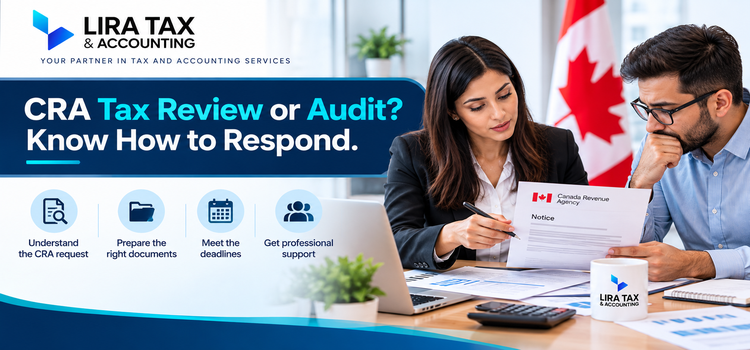
Received a CRA Review or Audit Letter? Here's What You Need to Know
Receiving a letter from the Canada Revenue Agency (CRA) about your tax return can be stressful. You may wonder whether you made a mistake, owe additional taxes, or need to provide documents from several years ago.
The good news is that a CRA tax review does not automatically mean you are being audited or that you have done something wrong. The CRA regularly checks tax returns to confirm that reported income, deductions, and credits are accurate.
However, ignoring a CRA letter or missing a response deadline can create additional problems.
Whether you are an employee, self-employed professional, landlord, or incorporated business owner, understanding how CRA tax reviews and audits work can help you respond confidently and protect your financial interests.
At Lira Tax & Accounting, we help individuals and businesses organize tax records, prepare outstanding returns, review tax information, and respond to CRA correspondence.
1. What Is a CRA Tax Review?
A CRA tax review is a process used to verify information reported on an income tax return.
The CRA may ask you to provide supporting documents for specific deductions, credits, or income amounts.
Common items selected for review include:
- Charitable donation receipts
- Medical expense claims
- Tuition and education amounts
- Moving expenses
- Employment expenses
- Rental income and expenses
- Self-employment income and business deductions
- Investment income and capital gains
For example, suppose you claimed $5,000 in charitable donations on your personal tax return. The CRA may request official donation receipts to confirm that the claim is eligible.
If your documents support the claim, the CRA may accept it without adjustment. If the documents are insufficient, the CRA may reduce or disallow the deduction or credit.
Important: Being selected for review does not necessarily mean your return contains an error.
2. CRA Tax Review vs. CRA Tax Audit: What's the Difference?
Although people often use the terms interchangeably, a CRA tax review and a CRA tax audit are not the same.
- CRA Tax Review
- CRA Tax Audit
- Usually examines specific claims or amounts
- May examine a wider range of tax records
- Often involves submitting receipts or documents
- May involve detailed examination of financial records
- Common for personal income tax returns
Can involve individuals, corporations, and GST/HST accounts
Usually focused on verifying particular information
May examine accounting records, transactions, and compliance
May result in no change or a reassessment
May result in no change, adjustments, or reassessments
A review is generally narrower in scope, while an audit may involve a more detailed investigation of financial information.
Both processes require accurate documentation and timely communication.
3. Why Does the CRA Select Tax Returns for Review or Audit?
The CRA uses several methods to identify returns that require verification.
Common reasons include:
Differences Between Reported Income and CRA Records
The CRA receives information from employers, banks, financial institutions, and other organizations.
If your reported income differs from information slips such as T4, T4A, T5, or T3 slips, the CRA may request clarification.
Large or Unusual Deductions
Significant business expenses, charitable donations, or other deductions may require additional supporting documentation.
A large deduction is not automatically incorrect, but taxpayers must be able to support eligible claims.
Missing or Inconsistent Information
Incomplete records, discrepancies between tax returns, or differences between reported sales and GST/HST filings can raise questions.
Previous Compliance Issues
A history of late filings, unreported income, or unresolved CRA requests may be relevant to the CRA's compliance activities.
Routine Verification
Some returns are selected as part of regular compliance programs, even when there is no indication of wrongdoing.
4. What Should You Do After Receiving a CRA Review Letter?
If you receive a CRA review or audit notice, take the following steps.
Step 1: Read the Letter Carefully
Identify:
The tax year under review
The specific deduction, credit, or income amount being questioned
- The documents requested
- The response deadline
- The CRA reference or case number
- The submission instructions
Do not assume that the CRA is reviewing your entire tax return. The letter should explain what information is required.
Step 2: Verify the CRA Communication
Before sharing personal or financial information, confirm that the request is legitimate.
You can review correspondence through your CRA online account or contact the CRA using its official published contact information.
Be cautious about suspicious emails, text messages, payment demands, or requests for sensitive information through unfamiliar links.
Step 3: Gather Supporting Documents
Depending on your situation, the CRA may request:
T4, T4A, T5, or other income slips
- Donation receipts
- Medical receipts
- Tuition certificates
- Bank statements
- Business invoices and expense receipts
- Rental agreements and expense records
- Payroll records
- GST/HST reports
- Financial statements
- Vehicle mileage logs
Ensure that the documents relate to the correct tax year and support the amounts claimed.
Step 4: Review Your Original Tax Return
Compare the CRA's request with the information originally filed.
Check whether the amounts were reported correctly and whether the supporting documents match the claimed deductions or credits.
If you discover an error, consider obtaining professional tax assistance before responding.
Step 5: Respond Before the Deadline
Submit the requested information within the timeframe specified in the letter.
For eligible review programs, the CRA allows documents to be submitted securely through My Account or Represent a Client.
Include the reference number and retain copies of everything submitted.
If you need additional time, contact the CRA using the information in the letter before the deadline.
Step 6: Keep Records of Your Response
Maintain copies of:
- The original CRA letter
- Supporting documents
- Written explanations
- Submission confirmation numbers
- CRA correspondence
- Any subsequent assessment or reassessment
These records may be important if additional questions arise.
5. What Happens If You Ignore a CRA Review Letter?
Ignoring a CRA request can have financial consequences.
If you fail to provide sufficient documentation, the CRA may disallow the deduction or credit being reviewed.
For example:
You claimed $4,000 in eligible medical expenses but did not provide the requested receipts.
If the CRA disallows the claim, your tax return may be reassessed, potentially resulting in additional tax owing and applicable interest.
In some cases, penalties may also apply depending on the circumstances.
The best approach is to respond promptly, even if you cannot locate every document.
If documents are missing, explain the situation to the CRA and ask what alternative evidence may be acceptable.
6. How to Prepare for a CRA Tax Audit
A CRA audit may involve a detailed examination of your financial records, business transactions, tax returns, or GST/HST filings.
For business owners, preparation should begin with organized accounting records.
Review Your Bookkeeping
Ensure your accounting records accurately reflect your business income and expenses.
Review general ledger transactions, bank reconciliations, accounts receivable, accounts payable, and financial statements.
Reconcile Business Income
Compare reported revenue with bank deposits, invoices, sales records, and GST/HST filings.
Investigate any differences before providing explanations to the auditor.
Verify Business Expenses
Confirm that expenses are properly documented and that personal expenses have not been incorrectly deducted as business expenses.
Organize GST/HST Records
Maintain invoices, sales records, GST/HST returns, and documents supporting input tax credits.
Review Payroll Records
For businesses with employees, organize payroll registers, T4 slips, source deduction records, and CRA remittance confirmations.
Communicate Professionally
Answer questions accurately and provide the information requested.
If the scope of an audit or a request is unclear, seek clarification. Professional assistance can help ensure that your response is organized and complete.
7. What If You Have Unfiled Tax Returns?
Unfiled tax returns can create additional complications, particularly when the CRA has already contacted you about outstanding filing obligations.
The CRA has a Non-Filer Program that identifies taxpayers who are required to file returns but have not done so.
Depending on the circumstances, the CRA may request outstanding returns, issue assessments using available information, or take further compliance action.
If you have missed one or several years of tax filings, taking action promptly is important.
Steps to Address Unfiled Tax Returns
- Identify the missing tax years.
Determine which personal, corporate, or GST/HST returns remain outstanding.
- Gather previous years' financial records.
Collect available income slips, bank statements, invoices, expense records, and financial statements.
- Prepare accurate outstanding returns.
Each return should reflect the applicable tax rules and financial information for that year.
- Review potential penalties and interest.
Late filing can result in penalties and interest where tax is owing.
- Consider available compliance options.
Depending on the circumstances, the CRA's Voluntary Disclosures Program may provide relief for eligible taxpayers who voluntarily correct past tax non-compliance.
However, eligibility is not automatic, particularly when the CRA has already started compliance action relating to the issue.
- Establish an ongoing filing system.
Keep your bookkeeping current and track future filing and payment deadlines.
At Lira Tax & Accounting, we assist clients with previous years' personal and corporate tax returns and help organize the financial information needed to address outstanding filings.
8. Can the CRA Review Previous Years' Tax Returns?
Yes. The CRA can review information from previous tax years.
Generally, the normal reassessment period is three years for most individuals and Canadian-controlled private corporations, and four years for certain other corporations, measured from the original notice of assessment.
However, exceptions can permit reassessment beyond those periods, including certain cases involving misrepresentation attributable to neglect, carelessness, wilful default, or fraud.
The CRA generally requires taxpayers to retain supporting records for at least six years, subject to applicable exceptions and special retention rules.
If the CRA requests documents from previous years, review the tax period carefully and seek assistance if records are missing or the reassessment rules are unclear.
9. What If You Disagree With a CRA Reassessment?
If the CRA changes your tax return following a review or audit, you may receive a Notice of Reassessment.
Before taking action:
Review the reassessment carefully.
Compare the CRA's changes with your original tax return.
Identify any missing documents or incorrect assumptions.
Determine whether the CRA's review program can reconsider the adjustment.
Consider filing a formal Notice of Objection if necessary.
For many corporate income tax assessments, the objection deadline is 90 days from the date of the notice.
For most individuals, the deadline is generally the later of 90 days after the notice or one year after the applicable filing deadline.
Different rules may apply to particular assessments and tax types.
Do not assume that contacting the CRA informally extends your objection deadline.
For complex disputes, professional tax or legal advice may be appropriate.
10. How Lira Tax & Accounting Can Help With CRA Reviews and Audits
Responding to a CRA request can be time-consuming, especially when financial records are incomplete or several tax years are involved.
Lira Tax & Accounting provides accounting and tax compliance support to individuals, self-employed professionals, and incorporated businesses.
Our services include:
CRA Correspondence Assistance
Helping clients understand CRA requests, organize relevant information, and prepare responses within the scope of our services.
Personal Tax Return Preparation (T1)
Preparing personal income tax returns and reviewing supporting documentation for eligible deductions and credits.
Corporate Tax Return Preparation (T2)
Assisting incorporated businesses with corporate tax preparation, financial records, and compliance requirements.
Previous Years' Tax Filing
Preparing outstanding personal and corporate income tax returns to help clients address past filing obligations.
Bookkeeping and Bank Reconciliation
Organizing financial records and reconciling transactions to support accurate tax reporting.
GST/HST and Payroll Support
Assisting businesses with GST/HST filings, payroll records, and related CRA reporting obligations.
Whether you received a CRA document request, need help organizing business records, or have several years of unfiled returns, professional assistance can make the process easier to manage.
11. Frequently Asked Questions About CRA Tax Reviews and Audits
Is a CRA tax review the same as an audit?
No. A tax review generally verifies specific claims or amounts, while an audit may involve a broader examination of financial records and tax compliance.
Does receiving a CRA review letter mean I owe money?
Not necessarily. The CRA may simply need receipts or other documents to verify your tax return. A review can end without any adjustment.
How long do I have to respond to a CRA review letter?
The deadline is stated in your CRA letter. If you need additional time, contact the CRA before the deadline and request an extension.
Can I respond to a CRA review online?
For eligible review programs, you or your authorized representative can submit supporting documents securely through CRA My Account or Represent a Client.
What if I cannot find my receipts?
Contact the CRA and explain the situation. You may be able to obtain duplicate receipts or provide other relevant supporting documents, depending on the claim.
Can the CRA audit a small business?
Yes. Sole proprietors, corporations, and other businesses may be selected for audits or compliance reviews.
Can I file old tax returns if the CRA has already contacted me?
Yes. Outstanding returns can still be prepared and filed, but the CRA's existing compliance action may affect available relief options. Respond to any formal filing demand within the specified deadline.
Can an accountant help me respond to the CRA?
Yes. An authorized tax representative can assist with tax records, explanations, and correspondence within their professional scope. Certain disputes may require specialized tax or legal representation.
12. Final Thoughts: Respond Early and Keep Accurate Records
Receiving a CRA review or audit notice does not automatically mean you have made a mistake.
What matters is how you respond.
Review the letter carefully, gather the requested documents, meet the deadline, and keep copies of your communications.
If you have unfiled tax returns, incomplete bookkeeping, or questions about a reassessment, addressing the issue early may help prevent additional complications.
Need Help With a CRA Tax Review, Audit, or Unfiled Tax Returns?
Lira Tax & Accounting helps individuals and businesses with tax preparation, previous years' tax filing, bookkeeping, GST/HST, payroll, and CRA correspondence.
Whether you need assistance with a CRA review letter or want to bring your outstanding tax returns up to date, our team can help you understand the next steps.
Contact Lira Tax & Accounting today:
📍 Serving Toronto, East York, Scarborough, and clients across Canada.
Lira Tax & Accounting | Your Partner in Tax and Accounting Services
Disclaimer: This article provides general information about Canadian tax procedures and does not constitute legal or individualized tax advice. CRA requirements, deadlines, and available relief depend on the facts of each case.