Understanding the difference between personal tax and corporate tax in Canada is important, especially if you are self-employed, operate a small business, or own an incorporated company.
Many Canadians are unsure whether they need to file a T1 personal income tax return, a T2 corporate income tax return, or both. Others assume that registering a business automatically means they must file corporate taxes.
In reality, your tax filing responsibilities depend on how your business is legally structured, the type of income you earn, and your individual circumstances.
At Lira Tax & Accounting, we assist individuals, self-employed professionals, and incorporated businesses with personal and corporate income tax preparation, bookkeeping, and CRA compliance.
This guide explains the key differences between personal and corporate taxation in Canada, including tax rates, filing deadlines, eligible deductions, and what to do if you have outstanding tax returns.
1. What Is Personal Income Tax in Canada?
Personal income tax is the tax individuals pay on their taxable income.
The Canada Revenue Agency (CRA) generally requires individuals who meet certain filing conditions to report their income using a T1 Income Tax and Benefit Return.
Personal income may include:
- Employment income reported on T4 slips
- Self-employment and freelance income
- Rental income
- Investment income and dividends
- Taxable capital gains
- Pension and retirement income
- Other taxable income
For example, if you work as an employee and receive a T4 slip, your employment income is generally reported on your personal tax return.
If you operate a business as a sole proprietor, your business income is also generally reported through your personal income tax return.
Personal tax returns help determine whether you owe additional income tax, qualify for a refund, or are eligible for certain government benefits and tax credits.
Who Needs to File a Personal Tax Return?
You may be required to file a personal income tax return if you:
- Owe income tax for the year
- Are required by the CRA to file
- Have certain taxable income or reporting obligations
- Need to report particular transactions or repay certain benefits
Even when filing is not mandatory, submitting a return may help you receive eligible refunds, credits, and government benefits.
2. What Is Corporate Income Tax in Canada?
Corporate income tax applies to corporations, which separate legal entities from their shareholders.
Most corporations operating in Canada must file a T2 Corporation Income Tax Return for each tax year, even when they have no taxable income or no taxes owing.
Corporate taxable income may include:
- Revenue from selling products or services
- Business and professional income
- Rental and investment income
- Taxable capital gains
- Other income earned by the corporation
For example, if you operate an incorporated consulting company in Toronto, the company generally files a T2 return to report its taxable income.
If you receive a salary or dividends from that company, you may also need to report those amounts on your personal T1 return.
This distinction is important because the corporation and its owner are generally treated as separate taxpayers.
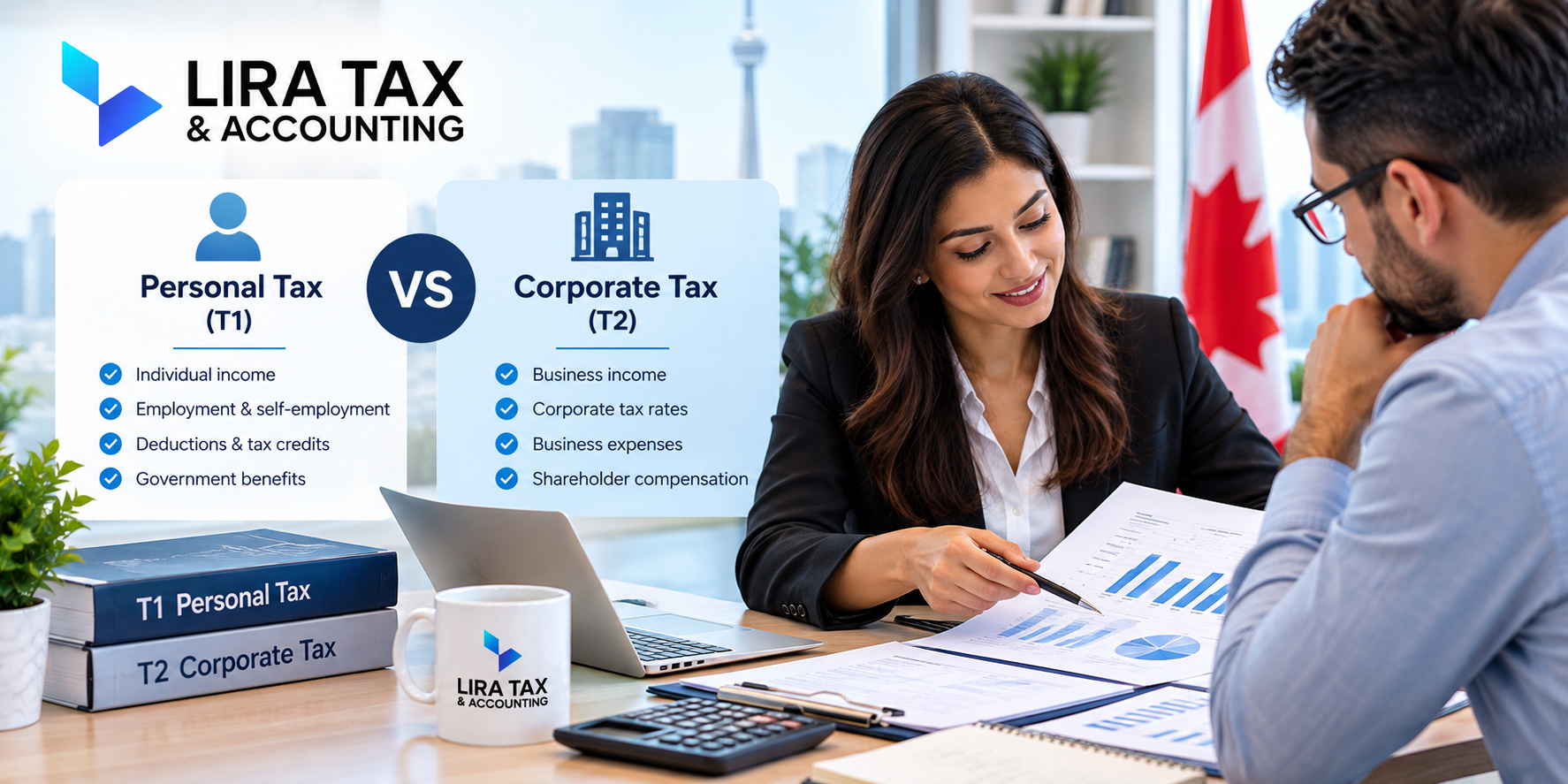
3. Personal Tax vs. Corporate Tax: Key Differences
Although both types of income tax are administered by the CRA, they have different rules and filing requirements.
| Feature | Personal Tax | Corporate Tax |
|---|---|---|
| Taxpayer | Individual | Corporation |
| Main tax return | T1 | T2 |
| Income reported | Employment, self-employment, investments, and other personal income | Income earned by the corporation |
| Tax rates | Progressive income tax rates | Corporate rates based on income type and eligibility |
| Tax year | Generally calendar year | Corporation's fiscal year |
| Filing deadline | Usually April 30, with certain exceptions | Six months after fiscal year-end |
| Tax payment deadline | Generally April 30 | Generally two or three months after fiscal year-end |
| Common deductions | RRSP contributions, eligible personal deductions and credits | Eligible business expenses and corporate deductions |
| Main records | Tax slips, receipts, and personal income records | Financial statements, general ledger, and corporate tax schedules |
Important: Sole proprietors generally report business income on their T1 returns. Incorporation creates a separate corporate income tax filing obligation.
4. How Are Personal Income Tax Rates Calculated in Canada?
Canada uses a progressive personal income tax system.
This means different portions of your taxable income are taxed at different rates.
For 2026, the federal personal income tax brackets are:
| Federal taxable income | Tax rate |
|---|---|
| Up to $58,523 | 14% |
| $58,523.01 to $117,045 | 20.5% |
| $117,045.01 to $181,440 | 26% |
| $181,440.01 to $258,482 | 29% |
| Over $258,482 | 33% |
Provincial or territorial income taxes also apply.
For example, an Ontario resident generally pays both federal and Ontario income tax.
A common misunderstanding is that moving into a higher tax bracket means all your income is taxed at the higher rate.
That is not how Canada's progressive system works. Only the portion of taxable income within each bracket is taxed at that bracket's rate.
Tax credits, deductions, and other adjustments can affect the final amount payable.
5. How Are Corporate Income Tax Rates Calculated?
Corporate income tax rates depend on several factors, including:
- Whether the company is a Canadian-controlled private corporation (CCPC)
- Whether its income qualifies for the small business deduction
- The province or territory where income is allocated
- The type of income earned
- Applicable corporate tax rules and deductions
At the federal level, the general net corporate income tax rate is 15%.
Eligible CCPC income qualifying for the federal small business deduction is generally taxed at a federal rate of 9%.
Provincial or territorial corporate taxes apply in addition to federal taxes.
Example: Small Business Corporate Tax in Ontario
Assume an eligible Ontario CCPC earns $100,000 in taxable active business income that qualifies for both federal and Ontario small business rates.
| Description | Amount |
|---|---|
| Corporate taxable income | $100,000 |
| Federal small business tax (9%) | $9,000 |
| Ontario small business tax (3.2%) | $3,200 |
| Total estimated corporate income tax | $12,200 |
| Estimated after-tax corporate income | $87,800 |
This simplified example assumes the full amount qualifies for the applicable small business rates and excludes other taxes, credits, and adjustments.
Important: The after-tax income belongs to the corporation. If the owner later withdraws money as salary or dividends, additional personal tax considerations arise.
6. Sole Proprietorship vs. Corporation: Which Tax Return Do You Need?
One of the most common questions small business owners ask is whether they should file personal or corporate taxes.
The answer depends on the legal structure of the business.
Sole Proprietorship
A sole proprietorship is generally not treated as a separate legal entity from its owner.
For income tax purposes, the owner reports business income and expenses on their personal T1 return, commonly using Form T2125.
Example:
You operate a freelance graphic design business and earn $70,000 in revenue.
Your eligible business expenses total $20,000.
Your net business income is:
$70,000 − $20,000 = $50,000
The $50,000 is generally included in your personal income tax calculation, along with any other taxable income.
Self-employed individuals may also have Canada Pension Plan contribution obligations.
Incorporated Business
An incorporated company is generally a separate taxpayer.
The corporation reports its income and expenses through a T2 return.
Example:
You own an incorporated marketing company that earns $150,000 in revenue and incurs $80,000 in deductible expenses.
Its income before any further tax adjustments is:
$150,000 − $80,000 = $70,000
The corporation generally reports its taxable income through a T2 return.
If you receive salary or dividends from the company, those amounts are generally reported on your personal T1 return.
As a result, an incorporated business owner may need to file both a personal and a corporate tax return.
7. Personal Tax vs. Corporate Tax Deductions
Understanding eligible tax deductions can help individuals and businesses calculate their taxable income correctly.
Common Personal Tax Deductions and Credits
Depending on eligibility, individuals may claim:
- Registered Retirement Savings Plan (RRSP) deductions
- Eligible employment expenses
- Childcare expenses
- Moving expenses
- Tuition tax credits
- Medical expense tax credits
- Charitable donation tax credits
- Eligible self-employment business expenses
Some items reduce taxable income, while others reduce income tax payable through tax credits.
Common Corporate Tax Deductions
Corporations may generally deduct reasonable expenses incurred to earn business income, subject to applicable tax rules.
Examples include:
- Office rent
- Employee salaries and wages
- Accounting and professional fees
- Business insurance
- Advertising and marketing
- Office supplies
- Eligible vehicle expenses
- Software subscriptions
- Capital cost allowance on eligible depreciable assets
Not every business expense is fully deductible. Some expenses have limitations, and capital purchases may require special tax treatment.
Proper bookkeeping and supporting documentation are essential for accurate corporate tax preparation.
8. Personal and Corporate Tax Filing Deadlines in Canada
Missing a tax filing deadline may result in penalties, interest, and additional CRA correspondence.
Personal Income Tax Deadlines
For the 2025 tax year:
- April 30, 2026: Filing deadline for most individuals.
- June 15, 2026: Filing deadline for most eligible self-employed individuals and their spouses or common-law partners.
- April 30, 2026: Payment deadline for personal income tax balances owing, including for self-employed taxpayers.
The self-employment filing extension does not generally extend the payment deadline.
Corporate Income Tax Deadlines
Corporations generally must file their T2 returns within six months after their fiscal year-end.
For example:
| Corporate fiscal year-end | T2 filing deadline |
|---|---|
| March 31 | September 30 |
| June 30 | December 31 |
| September 30 | March 31 of the following year |
| December 31 | June 30 of the following year |
Corporate income tax balances are generally due two months after the fiscal year-end.
Certain qualifying CCPCs may have three months to pay.
Filing and payment deadlines are separate obligations. A corporation may need to pay its tax balance before the T2 filing deadline.
9. What Happens If You Do Not File Personal or Corporate Taxes?
Unfiled tax returns can create financial and administrative problems for both individuals and corporations.
Depending on the circumstances, consequences may include:
- CRA late-filing penalties
- Interest on unpaid taxes
- Requests or demands to file
- Delayed personal tax refunds
- Interrupted income-tested government benefits
- CRA assessments or collection action
- Difficulties maintaining accurate financial records
For personal tax returns, the standard late-filing penalty generally applies when a balance is owing and the return is filed after the deadline.
Corporate late-filing penalties can also apply when a corporation has unpaid tax and files late.
In some circumstances, additional penalties may arise, including where a taxpayer repeatedly fails to file or does not comply with a formal CRA demand.
Can You File Previous Years' Personal Tax Returns?
Yes.
If you missed filing your personal income taxes for 2021, 2022, 2023, 2024, or 2025, you can generally prepare and submit the outstanding returns.
Each return must use the applicable tax rules and income information for that year.
Can You File Previous Years' Corporate Tax Returns?
Yes.
Corporations can also submit outstanding T2 returns for previous tax years.
However, overdue corporate filings may require additional work, such as reconstructing financial statements, reconciling bank accounts, and reviewing payroll and GST/HST records.
Corporate refund entitlement may also be affected by statutory filing deadlines.
Lira Tax & Accounting can assist individuals and incorporated businesses with organizing financial records and preparing outstanding tax returns.
For more information, read our related article:
How to File Unfiled Tax Returns in Canada
10. Should You Pay Yourself a Salary or Dividends from Your Corporation?
If you own an incorporated business, you may be able to receive compensation through salary, dividends, or a combination of both.
Each method has different tax implications.
Salary
Salary is generally deductible to the corporation when it meets applicable tax requirements.
It is reported as employment income on the individual's personal tax return.
Salary may also create RRSP contribution room and generally involve CPP contributions, subject to the applicable rules.
Dividends
Dividends are generally paid from corporate after-tax income.
They are not normally deductible by the corporation.
Shareholders report taxable dividends on their personal income tax returns, and the dividend gross-up and tax credit system may apply.
Which Option Is Better?
There is no single answer for every business owner.
The appropriate compensation strategy depends on personal income, corporate profits, retirement planning, cash flow, and other tax considerations.
A tax professional can help evaluate the overall personal and corporate tax consequences.
11. Common Tax Filing Mistakes to Avoid
Personal and corporate tax filing errors can result in reassessments, additional taxes, or delays.
Common mistakes include:
- Mixing personal and business expenses. Business owners should maintain accurate records and distinguish personal spending from deductible business costs.
- Assuming an incorporated company only needs a personal tax return. Corporations generally have separate T2 filing obligations.
- Missing filing or payment deadlines. Personal and corporate tax deadlines are different.
- Failing to report all income. Employment, business, investment, and other taxable income must be reported as required.
- Overlooking GST/HST obligations. Income tax filing and GST/HST filing are separate requirements.
- Not keeping proper bookkeeping records. Incomplete financial records can make tax preparation more difficult and increase the risk of errors.
- Ignoring previous years' unfiled returns. Delaying outstanding filings may create additional penalties and interest when taxes are owing.
Keeping organized financial records throughout the year can help prevent many of these problems.
12. Why Choose Lira Tax & Accounting for Personal and Corporate Tax Filing?
Tax preparation involves more than completing forms. It requires understanding the taxpayer's income, deductions, business structure, filing requirements, and supporting documentation.
At Lira Tax & Accounting, we provide accounting and tax preparation services for individuals, self-employed professionals, and businesses.
Our services include:
- T1 personal income tax preparation
- T2 corporate income tax preparation
- Previous year’s tax return preparation
- Self-employed and small business tax filing
- Bookkeeping and bank reconciliation
- GST/HST return preparation
- Payroll and related tax reporting
- Assistance with CRA correspondence
Whether you are filing your annual personal taxes, preparing a corporation's year-end return, or catching up on several years of outstanding filings, we can help you understand the information required and the next steps.
13. Frequently Asked Questions About Personal and Corporate Tax in Canada
1. What is the main difference between personal tax and corporate tax?
Personal income tax applies to individuals, while corporate income tax applies to corporations. Individuals generally use a T1 return, and corporations generally use a T2 return.
2. Do I need to file both T1 and T2 tax returns?
If you own an incorporated company, the corporation generally must file a T2 return. You may also need to file a personal T1 return to report salary, dividends, or other personal income.
3. Is corporate tax lower than personal tax in Canada?
Eligible small business corporate income may be subject to lower initial tax rates than some personal income. However, when corporate profits are distributed to shareholders, personal taxes may also apply. The overall tax result depends on the circumstances.
4. Does a sole proprietor file corporate taxes?
Generally, no. A sole proprietor reports business income on their personal income tax return unless they operate through a separate corporation.
5. Can I file corporate taxes if my business made no profit?
Yes. Most resident corporations are required to file a T2 return even when they have no taxable income or no payable tax.
6. What happens if I have not filed corporate taxes for three or five years?
You can generally prepare and submit outstanding corporate tax returns. You may need to reconstruct financial records and review CRA penalties, interest, and other filing obligations.
7. Can I claim business expenses on my personal tax return?
Yes, if you are self-employed and the expenses meet the applicable deduction rules. Eligible business expenses are generally reported as part of your business income calculation.
8. Can I file my personal and corporate taxes myself?
You may be able to prepare your own returns using appropriate tax software. However, professional assistance can be valuable when business transactions, payroll, dividends, capital assets, or previous years' unfiled returns are involved.
9. Does filing a T2 return also cover GST/HST?
No. Corporate income tax and GST/HST are separate tax obligations. A corporation registered for GST/HST may need to file separate GST/HST returns.
10. Can an accountant help with both personal and corporate back taxes?
Yes. A tax preparation firm offering both services can help organize outstanding T1 and T2 returns and identify related bookkeeping or CRA compliance issues.
14. Need Help with Personal or Corporate Taxes in Canada?
Understanding your tax obligations is the first step toward accurate filing and better financial planning.
Whether you are an employee, a sole proprietor, or the owner of an incorporated business, preparing the correct tax return is essential.
If you have missed filing previous year’s taxes, it is important to address the outstanding returns rather than allowing the problem to continue.
Lira Tax & Accounting provides professional personal and corporate tax preparation services for clients in Toronto, East York, Scarborough, and across Canada.
Contact Lira Tax & Accounting Today
Need assistance with personal income tax, corporate tax, or previous years' unfiled returns?
Contact our team to discuss your tax filing needs and determine the documents required to get started.
Get professional assistance with your personal and corporate tax filing. Contact Lira Tax & Accounting today.
Disclaimer: This article is intended for general informational purposes only and does not constitute personalized tax or legal advice. Tax rates, filing requirements, deadlines, and deductions may vary depending on the taxpayer's circumstances and applicable legislation. Consult a qualified tax professional before making tax-related decisions.